
Every year, thousands of Nigerians lose money, sometimes their entire life savings, on property purchases that turn out to have no legal standing. The land looks real. The seller seems legitimate. The documents appear genuine. But because the buyer did not understand what those documents actually meant, they end up with nothing enforceable in court.
This guide exists to make sure that never happens to you.
Nigerian land law is genuinely complex, rooted in the Land Use Act of 1978 and shaped by decades of state-level practice that varies from Lagos to Abuja to Port Harcourt. But the core concepts are what each document is, how they relate to each other, and what you must demand before parting with your money, and are entirely understandable once someone explains them plainly.
That is what this guide does.
Why land ownership in Nigeria works differently from what you might expect
The first thing to understand is a principle that surprises many buyers, especially those in the diaspora: in Nigeria, no private individual truly ‘owns’ land in the way that word is used in Western countries.
Under the Land Use Act of 1978, all land in every state of Nigeria is legally vested in the Governor of that state, who holds it ‘in trust’ for the people. What you acquire when you ‘buy’ land is not absolute ownership but a right of occupancy, the statutory right to use, develop, and benefit from a specific plot of land.
This is not a technicality. It has real consequences:
- Any transaction involving land that already has a Certificate of Occupancy (C of O) requires the formal approval of the Governor before it is legally complete.
- The government retains the right to revoke occupancy rights for public purposes, with compensation.
- All subsequent transfers of land must be properly documented and registered to be enforceable.
| Why this matters for buyers. When a seller tells you a property is ‘yours’ once you pay, they are technically incorrect until the transfer has been processed, consented to by the Governor, and registered. A receipt alone, even a substantial one, does not make you the legal occupant in the eyes of Nigerian land law. |
Let us walk through each of these in plain language.
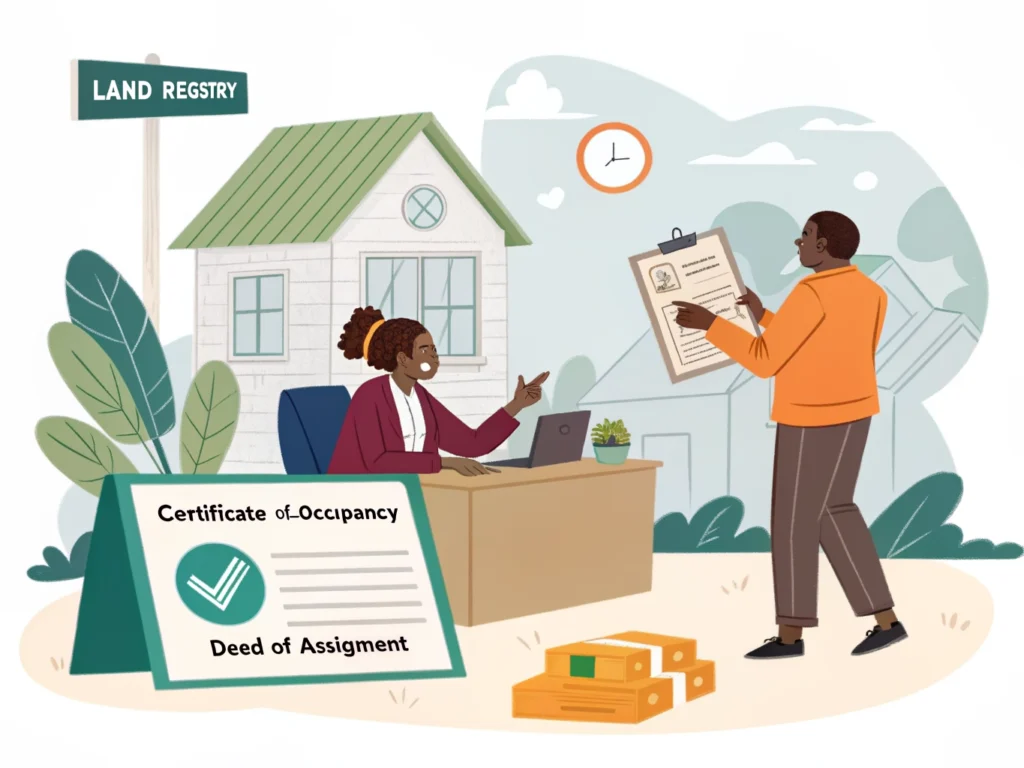
Certificate of Occupancy (C of O): the gold standard
A Certificate of Occupancy is issued directly by a state government. It is the government’s formal recognition that a specific individual or entity holds the statutory right of occupancy over a defined piece of land for a period of up to 99 years.
When you see a property advertised with a ‘Global C of O’, it means the entire estate or parcel has a single Certificate of Occupancy covering it, often held by the developer. Individual plots within it are then sold with Deeds of Assignment that carve out specific portions under that global title.
A C of O confers several critical protections:
- It confirms the government has formally recognised the occupancy right, reducing the risk of competing claims.
- It provides the legal foundation for obtaining a mortgage or loan against the property.
- It is the document that courts look to first when resolving ownership disputes.
| Important: A C of O has a file number that can and should be verified at the Land Registry. Do not accept a C of O at face value without running a formal search. Forged C of O documents are one of the most common forms of land fraud in Nigeria. |
Governor’s Consent: the mandatory step most buyers forget
Here is where many transactions go wrong. When you purchase land that already has a C of O, and the seller executes a Deed of Assignment transferring their interest to you, that deed alone is not legally complete.
Under Section 22 of the Land Use Act, any transfer of an interest in land that is covered by a Certificate of Occupancy requires the prior or subsequent consent of the State Governor. Without that consent, the transaction is technically void — meaning it has no legal force, even if you have paid in full and moved in.
In practice, the Governor’s Consent is processed through the state’s Land Bureau, not the Governor personally. The process involves:
- Submit the Deed of Assignment and supporting documents to the Land Registry.
- Paying the required consent fees (which vary by state and property value).
- The Land Bureau is processing and endorsing the consent on the deed.
- Stamping at the Stamp Duty office.
- Registration of the final document in your name.
| A common misconception Many buyers believe that once they have signed a Deed of Assignment and paid their money, they are done. They are not. The deed is only the agreement between two private parties. It becomes legally protective only once it has the Governor’s Consent and is registered. Until then, your interest is described in law as ‘equitable’ rather than ‘legal’ — which means it is significantly harder to defend in court. |
Deed of Assignment: the transfer document
A Deed of Assignment is the document through which the current title holder (the assignor) formally transfers their interest in the property to you (the assignee). It is drafted by a qualified property lawyer and must contain:
- Full names and details of both parties.
- A precise description of the property being transferred, including survey numbers and coordinates.
- The consideration paid (the purchase price).
- Reference to the root of the title — typically the C of O or previous deed from which the seller derives their right.
- The date of the transaction.
- Signatures of both parties and witnesses.
On its own, a Deed of Assignment is a private agreement. To become a fully protected legal document, it must be:
- Stamped at the relevant Stamp Duty office within the prescribed period.
- Submitted to the Land Registry to obtain Governor’s Consent (if the underlying title is a C of O).
- Registered at the Land Registry, so it becomes a matter of public record.
| A Deed of Assignment without Governor’s Consent and registration is incomplete. Do not make final payment until this process is underway, and structure any instalment arrangements so that the final tranche is only released once proper documentation is confirmed. |
Gazette and Excision: Understanding Community Land
Much of the land on the fringes of Lagos, in areas like Ibeju-Lekki, Epe, and parts of Ikorodu, was historically held by indigenous communities and families. Before a developer can legally sell this land, it must be ‘excised’: formally released by the government from its prior acquisition or reservation back to those communities, and recorded in the official government Gazette.
Excision is recorded in the Lagos State Official Gazette, a formal publication that lists the precise parcels of land that have been released. If land is excised and recorded in the Gazette, it can then qualify for a C of O or have Deeds of Assignment processed against it. If it has not been properly excised, it cannot legally hold a valid title.
| In 2026, any seller telling you that land is ‘excision in process’ should be treated with extreme caution. Either the excision is confirmed and recorded in the Gazette, or it is not. ‘In process’ is not a legal status — it is a holding phrase that has been used to facilitate significant fraud. |
If you are buying in an area where excision is relevant, you or your lawyer must:
- Physically verify that the specific Gazette volume and entry number confirm the excision of the land in question.
- Confirm that your specific plot falls within the excised area, not just that land nearby has been excised.
- Check that no government acquisition order overrides the excision.
Red flags: warning signs that should stop any transaction
With a clear understanding of the title hierarchy, the red flags become obvious. Here are the ones that matter most.
Documents that cannot be verified at the Land Registry
Every legitimate title document in Nigeria has a reference that can be cross-checked at the relevant Land Registry. If a seller’s C of O file number returns nothing at the Lands Bureau, or the search results do not match the details on the document, stop immediately. Forged C of O documents are produced with convincing formatting — do not rely on how a document looks.
Pressure to skip or rush verification
Legitimate sellers welcome verification. It proves their title is clean and gives the buyer confidence. If a seller is pressing you to pay quickly because ‘another buyer is interested,’ or discouraging you from running a formal Land Registry search, treat this as a significant warning sign. The urgency is almost always manufactured.
Stamp duty paid to personal accounts
Stamp duty is paid to the government accounts, not to individuals or companies. If someone presents you with a ‘stamp duty receipt’ that is a screenshot of a bank transfer to a personal account, it is fraudulent. Official stamp duty payment generates a government receipt with a reference number.
Survey plans that do not match the physical site
A survey plan is prepared by a registered surveyor and shows the precise boundaries, coordinates, and beacon numbers of a plot. The surveyor’s name should be verifiable with the Surveyor General’s Office. If the coordinates on the survey plan do not correspond to the actual site when GPS-checked, or if the surveyor is not registered, do not proceed.
Multiple sellers or an unclear chain of title
Land fraud often involves a seller who genuinely owns the land but has already sold it to multiple buyers. The first buyer to properly register their interest wins. Always verify at the Land Registry that no prior registered interest exists before finalising your purchase.
Family land presented without formal documentation
Family or community land transactions are among the most legally precarious in Nigeria. If a seller says the land belongs to a family and they have the family’s authority to sell, you need far more than their word. You need a clear root of title showing the family’s original interest, evidence that the land has been properly excised, and ideally a C of O before proceeding. Omonile (community land) transactions without full documentation carry the highest risk of all.
How to properly verify land documents before buying
Document verification is not optional for a serious property purchase in Nigeria. Here is the process, step by step.
Step 1: Engage a qualified property lawyer
Before you do anything else, instruct a qualified Nigerian property lawyer who is independent of the seller and developer. They should not be referred to you by the seller. Their job is to act solely in your interest, and their expertise in local land law is essential to navigate the process correctly.
Step 2: Search the Land Registry
Your lawyer will submit the details of the C of O or existing deed to the relevant Land Registry (in Lagos, this is the Lands Bureau in Alausa, Ikeja). The search will confirm whether the title is genuine, whether it is registered in the seller’s name, and whether any encumbrances — mortgages, court orders, or government acquisitions — are recorded against it.
Step 3: For excision properties, check the Gazette
If the land is described as excised community land, physically verify the Gazette entry. Note the volume number, page, and the precise description of the land. Cross-reference the survey plan coordinates against the Gazette to confirm your plot is within the excised area.
Step 4: Verify the survey plan
Check the surveyor’s registration with the Surveyor General’s Office. Have a physical site inspection conducted to confirm that the beacon positions match the survey plan. In Lagos, the Ministry of Physical Planning and Urban Development can assist with plot number verification.
Step 5: Verify the developer (for off-plan and estate purchases)
Check the developer’s registration with the Corporate Affairs Commission (CAC). In Lagos, verify that the company is registered with LASRERA (Lagos State Real Estate Regulatory Authority) at lasrera.lagosstate.gov.ng. Request evidence of their previously completed projects and title documentation for those developments.
Step 6: Confirm no government acquisition
Ask your lawyer to check whether any part of the land is subject to a government acquisition notice. Acquired land cannot be privately sold, and acquisition orders are not always prominently advertised.
Title perfection: completing the process after purchase
Buying a property is not the end of the documentation process. To make your ownership fully enforceable, you need to complete what lawyers call ‘title perfection’: the full cycle of consent, stamping, and registration.
The steps are:
- Execute the Deed of Assignment with the seller, signed by both parties and witnessed.
- Submit for stamping at the Stamp Duty office within the prescribed time (penalties apply for late stamping).
- Submit to the Land Registry for Governor’s Consent, with the required supporting documents and consent fees.
- Once consent is obtained, register the deed at the Land Registry in your name.
Until registration is complete, your interest is equitable, not legal. That means if another buyer somehow registers a competing interest before you do, they may have priority. Always complete the perfection process, and do not wait.
| Timeframe and cost: Title perfection in Lagos can take anywhere from three months to over a year, depending on the workload of the Land Bureau and the completeness of your documentation. Costs include consent fees (typically calculated as a percentage of property value), stamp duty, and registration fees. Budget for this as part of your total acquisition cost, and instruct your lawyer to begin the process immediately after the exchange. |
What to ask a developer before you buy
Whether you are purchasing from M&N Properties or any other developer, these are the documentation questions you should ask before committing:
- What is the title on this development, and can I see it? (C of O, Gazette, excision — whatever the basis)
- Can I verify the title at the Land Registry before completing my purchase?
- What documentation will I receive when I buy: a Deed of Assignment, Governor’s Consent, or both?
- Are you registered with LASRERA and/or REDAN?
- Can I see evidence of previously completed projects and the documentation issued to buyers in those developments?
- Who will handle title perfection after purchase, and what are the associated costs?
A developer with clean documentation will answer every one of these questions confidently and transparently. Hesitation, deflection, or vague reassurances are signals to investigate further before proceeding.
Final word: documentation is not bureaucracy — it is your protection
It can be tempting to view land documentation as administrative tedium — an obstacle between you and the property you want. In Nigeria’s real estate market, that attitude has cost people their homes, their savings, and years of legal battles.
The good news is that understanding the title hierarchy, asking the right questions, and insisting on proper verification is entirely within reach of any buyer. You do not need to be a lawyer. You need to know what questions to ask, engage someone qualified to verify the answers, and refuse to be rushed.
The most valuable piece of land in Nigeria is the one with clean, verifiable, registered documentation behind it. That is true whether you are spending five million naira or five hundred million.
At M&N Properties, every development we bring to market comes with full title documentation that has been independently verified. We welcome buyers who ask detailed questions about our documentation — because a buyer who understands their title is a buyer who can buy with confidence.
| Buying property in Nigeria and want to understand the documentation on a specific development? Our team at M&N Properties Limited is happy to walk you through the full documentation package on any of our developments — before you commit a single naira. Visit mandnpropertiesltd.com or contact us directly to speak with a member of our team. |